
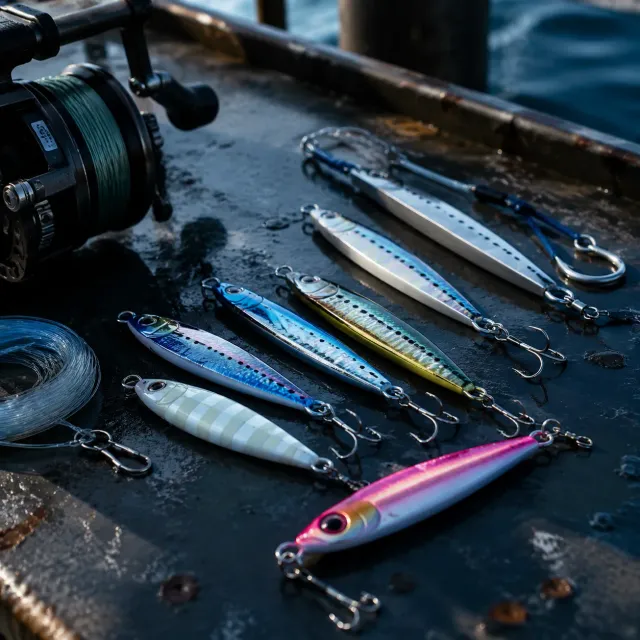
Choosing a metal jig starts with the conditions, not the fish name printed on a tackle label. Set the jig’s weight so it reaches and stays near the intended depth, choose an action that fits the fish’s feeding mood and your retrieve, then make sure the finish and hook arrangement still work in the available light and current.
For shore fishing, casting distance, bottom contact, and sweep from current often matter most. Offshore, the priority is usually controlled descent and a presentation that remains effective through the depth range where fish are holding. A metal jig selection guide should therefore begin with water depth, current, and the depth you need to fish, then narrow the choice by action, finish, and rigging.
Define the Fishing Scenario
Before choosing a metal jig, identify the part of the water column you need to cover. “Fishing deep” is too broad to select a useful weight or profile. A jig may need to reach bottom, pass through suspended fish, or stay just below surface activity. Each calls for a different setup.
Start with these questions:
- Are you casting from a beach, jetty, rocky shoreline, pier, boat, or kayak?
- What is the approximate depth at the intended strike zone?
- Is there tidal flow, wind-driven drift, surf, or strong current?
- Are fish feeding near the surface, suspended, or close to bottom structure?
- Do you need a long cast, a vertical drop, or both?
- Is the bottom clean enough to touch regularly, or is snagging a concern?
- What forage are you trying to resemble: slender baitfish, small dense bait, or a broader fluttering prey item?
A shore angler targeting Spanish mackerel, bluefish, striped bass, jacks, bonito, or false albacore may need a compact casting jig that covers water quickly. In contrast, a boat angler working reef edges, wrecks, ledges, or deep structure needs a jig that can fall predictably through current and remain in the strike zone.
Target species still matter, but primarily because they influence likely depth, forage size, and hook requirements. A fast-moving pelagic fish may respond to a rapid retrieve and narrow profile. Bottom-oriented fish may take a jig worked with shorter lifts and controlled falls. Do not assume that one metal jig will solve both jobs equally well.
Match Jig Weight to Depth and Current
Use the lightest jig that can reliably reach and maintain the desired depth while preserving a workable retrieve. A jig that is too light may drift out of the zone before it gets down. One that is too heavy can fall past fish too quickly, snag more often, or feel lifeless on a slow retrieve.
Depth alone does not determine jig weight. Current, wind, line diameter, boat drift, casting distance, and jig shape all change how fast a lure sinks and how much it sweeps.
| Fishing condition | Practical weight direction | What to watch for |
|---|---|---|
| Calm, shallow water with a short cast | Light to moderate | Keep enough weight to cast accurately and maintain feel |
| Surf, wind, or a long shore cast | Moderate to heavier, often compact | Wind resistance and line belly can prevent depth control |
| Moderate depth with manageable drift | Moderate | Count the fall and adjust before changing techniques |
| Deep water or stronger current offshore | Heavier or more compact | Confirm the jig reaches the zone before the boat drifts away |
| Suspended fish seen or located midwater | Weight that can stop at depth | An overly heavy jig can pass below the school before you engage it |
| Snag-prone rocks, wrecks, or reef | Only enough to maintain contact | Frequent hard bottom contact increases loss risk |
A useful on-water test is simple: cast or drop the jig, keep a reasonably direct connection to it, and note whether you can tell where it is. From shore, the jig should not immediately get swept sideways with no sense of depth. Offshore, it should descend on a controlled enough angle that you can work the intended layer before excessive line scope develops.
Use a sink-rate check instead of guessing
If you are not sure whether the jig is reaching the correct zone, count its fall. The count is not an exact depth measurement because line drag and current affect it, but it gives you a repeatable reference.
- Cast or drop the jig and close the bail or engage the reel as appropriate for the presentation.
- Count steadily while allowing a controlled descent.
- Start the retrieve at different counts until strikes, follows, or bottom contact reveal the productive layer.
- Increase weight or move to a more compact profile if the jig cannot get there consistently.
- Reduce weight or slow the fall if fish react only when the lure spends more time in a shallow or midwater layer.
Avoid relying on bottom contact as the only depth indicator. Fish may be suspended well above structure, and a jig repeatedly dragged on bottom can foul hooks, dull points, and increase snagging.
Compare Fast and Slow Pitch Actions
The phrase “fast pitch” usually describes a jig intended to respond sharply to rod input and descend relatively quickly, often with a tighter profile. “Slow pitch” generally refers to a jig designed to glide, flutter, or slide more noticeably as it falls and pauses. Actual behavior still depends on the specific jig shape, balance, line angle, and retrieve.
Neither action is inherently better. The better choice is the one that creates a controllable presentation at the depth and speed the fish want.
Fast-pitch jigs favor speed and direct control
A fast-pitch style jig is often useful when you need to get down quickly, work efficiently through a depth range, or trigger fish with a more assertive upward movement. It can suit faster retrieves, sharp rod lifts, and active feeding situations.
Choose this general style when:
- Current or depth makes a fast descent important.
- You need to cover several depths quickly.
- Fish are chasing bait and respond to a more urgent cadence.
- A streamlined casting profile helps from shore.
- You can keep the line reasonably direct and feel the jig.
The limitation is that an aggressive retrieve can pull the jig out of the zone quickly. It may also become less effective when fish are reluctant and need a longer fall or pause to commit.
Slow-pitch jigs emphasize the fall
A slow-pitch style jig is commonly selected for a more deliberate lift-and-fall presentation. After a controlled rod lift or reel turn, the jig is allowed to flutter, glide, or fall with slack managed closely enough to detect a strike.
Choose this general style when:
- Fish are concentrated near structure or a specific depth.
- The fall is likely to be the strike trigger.
- Fish ignore a fast, straight retrieve.
- You can fish a slower cadence without losing too much depth to drift.
- The jig needs to remain visible or available longer in a narrow zone.
Its limitation is control in strong current. A broad or slow-falling jig may plane away from the boat or sweep too far from the intended structure. In that situation, a more compact jig or added weight can be more practical even if the slow fall initially seems attractive.
For an example of a design positioned around both retrieve styles, review the Glow Fast Slow Pitch Jig. Confirm the product page’s listed sizes, weights, and rigging details before deciding whether a particular option fits your application.
Choose Finish and Glow Details
Finish is a visibility and contrast decision, not a substitute for reaching the fish. Start with a jig that has the correct weight and action; then select a finish that helps fish find or track it under the prevailing light, water clarity, and depth.
A bright, reflective finish can be useful in clear water, sun, or when fish are tracking small shiny bait. In low light, stained water, overcast conditions, or deeper water, contrast and glow features may be easier for an angler to use as part of a visibility strategy. However, no finish is universally effective, and a glow treatment does not overcome a jig that is moving through the wrong depth too quickly.
Use these practical comparisons:
- Reflective silver or baitfish-like finishes: A logical starting point when visible forage has a bright flash or when light penetration is good.
- Darker or high-contrast finishes: Useful to try when glare is excessive, the sky is overcast, or a more defined silhouette may stand out.
- Color accents: Can help an angler maintain confidence and organize choices, but should be tested against actual water clarity and feeding behavior rather than treated as a rule.
- Glow details: Worth considering for low-light, deep-water, or darker conditions. Charge the glow material according to its intended use, and recognize that glow duration and visibility vary with the product and environment.
Finish durability also affects the practical life of a jig. Inspect paint, eyes, split rings, and hook attachment points after contact with rocks, reef, wreck structure, or toothy fish. A scarred finish may still catch fish, but damaged hardware deserves attention before the next drop.
Review Hooks and Rigging
The jig body attracts attention; the hook setup converts strikes into hookups. Confirm the hook arrangement is compatible with the jig, your target fish, and the way you plan to retrieve it.
A common setup uses an assist hook at the top of the jig, a hook attached by a short cord or solid-ring connection. This placement can improve hookups when fish strike the upper portion of a vertically worked jig or grab it during the fall. Some setups also use a rear hook, particularly for faster retrieves or fish that strike from behind.
Each arrangement has tradeoffs:
| Rigging approach | Potential benefit | Main limitation |
|---|---|---|
| Top assist hook only | Fewer snag points; often suited to vertical jigging | May miss tail strikes during a fast retrieve |
| Top and rear hooks | More coverage for short strikes | Greater snag and foul-hook risk |
| Treble hook at the tail | Common for casting and chasing fish | Can snag structure, netting, or the angler more easily |
| Single rear hook | Less hardware than a treble | Hookup rate depends heavily on strike position and hook size |
Check several compatibility points before changing hooks:
- The hook gap must clear the jig body and any assist cord or leader.
- The hook strength should match the expected fish and drag setting.
- Split rings, solid rings, and swivels must be appropriately rated and in good condition.
- Hook points should be sharp and free of corrosion.
- The added hook weight should not materially disrupt the intended jig action.
- Local rules and the fishing situation may affect whether certain hook configurations are appropriate.
Do not automatically upsize every hook. A larger or heavier hook may look stronger but can interfere with flutter, foul around the leader, or reduce effective hook penetration. Match the setup to the lure’s intended size and presentation, then inspect it after every fish or hard impact.
Plan Retrieval and Fall Control
A metal jig is not a single-speed lure. Its value is the ability to change the retrieve, pause, and fall until you identify the trigger.
For shore fishing, begin with a cast long enough to cover the target zone, then vary the angle and speed before changing colors or lures. A higher rod tip can keep the jig shallower; a lower rod tip and slower cadence can help it work deeper. In surf or current, keep enough tension to feel the jig, but avoid reeling so quickly that it rises above the strike zone.
For offshore fishing, control slack on the descent. Many strikes occur during the fall, and a completely loose line can hide the take. That does not mean holding the jig rigidly tight. The goal is a controlled connection: enough line management to detect a strike while still allowing the jig to perform its intended fall.
Start with three repeatable cadences
Steady retrieve: Cast, allow a brief sink, then retrieve at a consistent pace. This is useful for covering water and targeting actively feeding fish.
Lift and fall: Raise the rod with a measured sweep, follow the jig down while managing slack, then repeat. This works well around depth changes and structure.
Short pitch and pause: Use compact rod inputs or a few reel turns, then pause long enough for the jig to fall. This is a practical way to test whether fish are responding to the descent rather than speed.
Change one variable at a time. If you switch weight, finish, hook arrangement, depth count, and retrieve speed all at once, you will not know what improved the response. Keep notes on current direction, productive count, retrieve cadence, and where strikes occur. That discipline is particularly useful for anglers and buyers comparing several jig styles across repeated trips.
Compare Metal Jig Product Options
When comparing metal jig options, look beyond a product name or color. A practical assortment covers the fishing situations you actually expect to encounter: a casting-oriented option, a depth-and-current option, and a fall-oriented option can be more useful than multiple near-identical jigs.
Use this comparison framework when reviewing a metal jig category:
| Selection factor | What to compare | Why it matters |
|---|---|---|
| Weight range | Available weights within one profile | Lets you preserve action while adjusting for depth or current |
| Body profile | Long and narrow, compact, broad, or asymmetric | Influences casting, sink behavior, and retrieve response |
| Balance and action | Fast response, flutter, slide, or mixed behavior | Determines how the jig reacts to rod input and fall |
| Finish options | Reflective, contrast, glow, and available patterns | Helps tailor visibility after weight and action are correct |
| Hook configuration | Included hooks, attachment points, and rigging compatibility | Affects hookup potential, snags, and replacement planning |
| Hardware details | Rings, swivels, cords, and replacement compatibility | Important for maintenance and safe rigging |
| Intended use | Shore casting, vertical jigging, or flexible use | Helps avoid forcing one lure into an unsuitable role |
For a retail or sourcing assortment, compare the documented product specifications rather than assuming that visually similar jigs perform the same way. Confirm listed weight variants, dimensions where provided, included hooks, and intended rigging. Also consider whether replacement hooks and storage can be handled consistently across the assortment.
WKLURE’s product catalog includes tackle categories beyond metal jigs, which can be useful when reviewing related lures, hooks, rods, or storage needs. Product pages are the appropriate source for model-specific specifications.
Use a Final Selection Checklist
Use this checklist before tying on a jig or adding one to a tackle assortment:
- Is the jig heavy enough to reach the target depth in the current and wind?
- Is it light enough to stay in the strike zone without excessive bottom snagging or an uncontrolled drop?
- Does its profile fit the casting distance, drift, and fall rate required?
- Does the action support a fast retrieve, a controlled fall, or the presentation you intend to use?
- Is the finish appropriate for current light, water clarity, and depth?
- If using glow, can you charge and fish it effectively for the conditions?
- Are the hooks sharp, correctly sized, and suitable for the expected fish and structure?
- Are split rings, assist cords, leaders, and knots in sound condition?
- Can your rod, reel, line, and leader handle the jig weight and retrieve style?
- Have you selected a starting depth count and a retrieve cadence to test systematically?
The most common mistake is selecting a jig by color or target species before confirming its depth control. Get the weight and profile right first, then refine the action, finish, and hooks based on what the water and fish show you. Review the available metal jig options against this checklist to build a practical shore or offshore selection.